Time to Read:
There are a few short axioms that hold true on this wild roller coaster ride of human existence – quick syllables that sum up the whole of what it is to be human.
Life is short.
S*%$t happens.
And, tone matters.
There is no place that I have encountered the latter to be more true than in tackling studying Mandarin Chinese.
Chinese is a tonal language.
Before I landed in Guilin, China and started my studies at the Chinese Language Institute, though I had a general sense of what that means, I didn’t really understand. I only knew that it intrigued me, that it excited and fascinated me and that it intimidated the holy heck out of me.
On the simplest level, I understood coming into my studies that the way in which you say a word changed the meaning of it. I knew that the word “ma” for example could mean things as different as mother, horse and “?” It seemed so abstract to me that I could change the meaning of a word by hitting the right notes – and scary.
And, not only that, there was another hitch I was stuck on. It seemed, at first glance, that all languages are tonal languages, that you can always change the meaning of a word by the tone with which you say it. I didn’t really understand, then, what made Chinese a tonal language and my mother tongue of English, for example, not. Anyone that has every attempted a human relationship with, well, anyone, in English, knows very well that tone matters.
“It’s not WHAT you say, it’s how you say it.”
“I don’t think I like your tone.”
“Wait, did he say it like, “this” or like “this”?”
“I don’t like your tone, young lady!”
“Don’t you take that tone with me!”
As previously mentioned, life is short, s*%$t happens and, tone DEFINITELY matters.
What I didn’t understand before I got my feet wet in the shallow end of this fantastic language, was that there is a (BIG) difference between “tone” and “intonation”.
All languages (at least the ones I’ve encountered) are affected by “intonation” (including Chinese). The combination of pitches and tones you use to say any word can completely change the meaning of what you are saying, but that does not a tonal language make.
Ryan and I often find ourselves laughing playing out the different meanings of phrases depending on what tone you use. Take the word, “Why?” You could make that mean so many different things without changing the word. I’ll give you the list of meanings and, if you are a fluent English speaker (and maybe even if not) I KNOW, instantaneously, you will know what tone to use.
Ask a friend near to say the word, “why”, but to give it each of these different meanings, and, I’m willing to bet good money, you will find that you would have said the word in the same set of tones they used. Give it a go. It’s fun.
“Why?” = What is the reason? As a simple statement, or to start a question of simple, unemotional inquiry, like, “Why is the sky blue?
“Why?” = Why should I do that? I don’t have to do that if I don’t want to do that. You are not the boss of me.
“Why?” = Why has life forsaken me? What have I done to deserve this?!
“Why?” = Hmm, that’s interesting. I’m curious why that is.
“Why?” = Why me? I am so tired. I just can’t take anymore.
“Why?” = Why do birds….suddenly appear…everytime…you are near…
We all know the tones. In English, no one ever teaches you them specifically. There is no way to spell them. No one learning English as a second language has a chapter in their textbook called, “the many tonal meanings of the word ‘why’”. They show up in no dictionary. I’m even guessing that AI doesn’t know them. But everyone that speaks the language does. They are clear, repeatable and widely understood and utilized parts of English. Despite having no official linguistic role, the amazing thing to me is, no matter who you play this game with, I’m willing to put good money down that they are all going to use the SAME tones to convey those meanings – because there is an actual tonal spelling, a consistent set of pitches that we use to convey specific meanings even though there is no place they are officially recorded. These are not random changes in tones – they are recognizable, repeatable tonal carriers of meaning in English!
Key and Peele (an hilarious American comedy duo) know all about this!
Rob Schneider (American comedian) gets it.
The English language is replete with tones!
Some intonations are universal, others are specific to specific cultures. One of my favorite “words” that I’ve ever learned is the Japanese word for, “Oh my gosh, really?!” It’s not a word at all. It’s just a very specific set of tones and I expect to hear it all over the place during my time in Japan.
So, I already understood the power of tone in making meaning long before studying Chinese.
But Chinese is different. Being “tonal” is totally different than the impact of intonation and understanding it is central to mastering Chinese pronunciation.
And right there is the rub.
Tones are part of Chinese pronunciation.
Wait, what?!
When my Chinese teacher, Annie, first told me that my pronunciation was good, that what I was saying was “clear”, my brain just about exploded, because we were working on tones at the time.
For all of the comprehension I have about the power of intonation to change the meaning of words, the idea that tones are part of correct pronunciation hurt my brain a little bit.
Up until that moment, pronunciation was always a word I associated with articulation. Articulation is something your mouth and all its various parts does. When you don’t enunciate clearly, when you mumble, when you use the wrong shape of your mouth, these are all incidents of poor pronunciation. This would be the first time that I was not just going to have to will my mouth full of stubborn muscles to form different shapes than it is used to, but, this time, I have to convince my larynx that it is part of this effort too.
Your vocal chords are down in your throat producing pitch by vibrating at different frequencies. Phonetic sounds, however, get created right there at the front door. Your mouth, lips, teeth and tongue all do their thing to make all of those fantastic vowels and consonants. In Chinese, you’ve got to make sure all of them are working together if you want to be enunciating clearly.
And, pronunciation matters. It really matters. There are times that I have heard someone speak English and I couldn’t understand what they were saying – even though they were using the right words, the right grammar, (after I figured out what they were saying, I could tell those things were correct) the sounds weren’t right – and I couldn’t get it.
And, pronunciation is not just important to actually be able to communicate. As far as I’m concerned, when it comes to language learning, pronunciation is the secret sauce, the x-factor, the magical portal you walk through to go from not knowing a language to knowing it. For me personally, it is the key to the whole process. It is the giant gate at the beginning of the path that I must pass through to get on the path to learning that language. Once I understand how a language is meant to sound, that is when I begin tap into the essence of it.
For me, there is some kind of alchemical transmutation that happens during the process of convincing the muscles in my mouth to operate in a different way than they are used to. It’s not about being able to speak without the traces of my native sounds. Having good pronunciation is not about not having an accent, but, to me, it is about stretching myself as far out of the territory of what is most automatic to me into an alternate aural world.
Every language, every culture lives in a sonically unique universe. When you push yourself to find good pronunciation in a language, you become an astronaut hurtling through space into this other cosmos. Once you are dancing to the music of a different language, though, in my experience, all the other pieces of what makes a language work start to fall into place. The grammar, the vocabulary, the turns of phrase, they all make more sense, they all fit together in this ecology of sound and meaning that is a language.
Learning a language is a form of space travel. When you are too attached to your native sounds, your whole brain is trying to stay in the mindset of your mother tongue. When you let go of the sounds and the rhythms you are used to and find a way to surrender into another language’s sounds, then your brain opens up to let a knew way of thinking, a new way of relating to language and to communication. You can’t have one foot on the dock and get in the water. If you want to swim, you’ve got to jump. To me, that’s what pronunciation is. It’s the leap from the safety and comfort of what you know into new waters.
Well, before I started my focused studies in Chinese 2 weeks ago, that giant gate at the beginning of the language journey that is pronunciation was padlocked, blockaded and vaulted shut! My feet felt tethered to the dock and I couldn’t figure out how to jump even though I wanted to!
In my first lesson with my teacher, I made it clear to her that this was a hurdle for me. She had already planned to do some work on pronunciation, but, before long, we agreed that, for me, I would need more than just some. I needed to unlock that gate, and no mild knock on the door was going to do it. We needed a friggin’ battering ram. For the first 3 days of class, we spent the entire 2 hours just making sounds, running phonetic and tonal drills over and over…and over (and over).
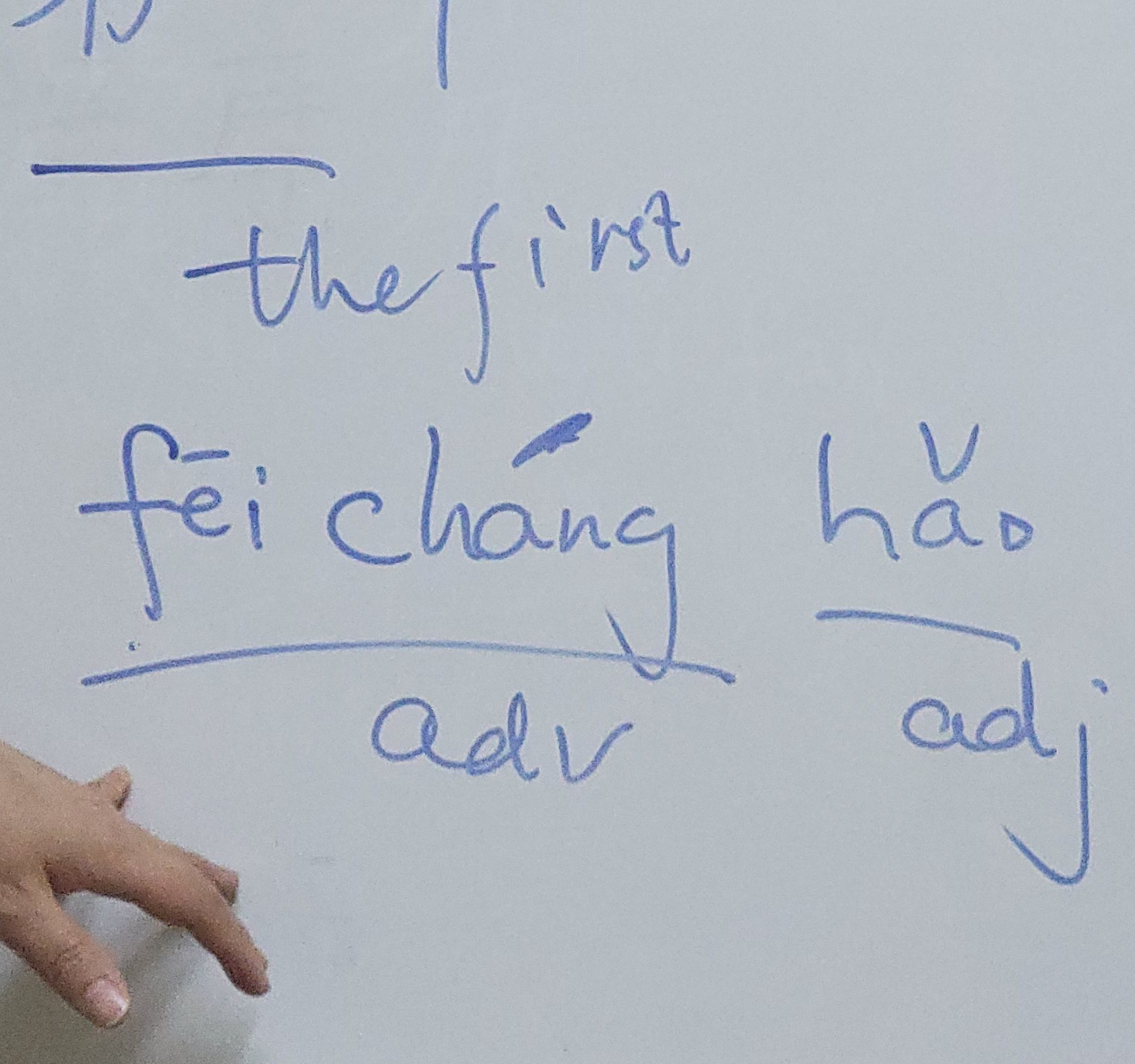
Chinese has a phonetic alphabet known as pinyin. It uses latin letters in combination with 4 different accent marks that represents the four tones. There is a chart that details every single possible phonetic combinations in Chinese. If you can make all of the sounds on this chart, then you can pronounce every word that exists in Chinese. My teacher and I would just go over all of the sounds in the chart, each with all four tones, over and over and over. Then we would move onto practicing words with different combinations of tones to get my larynx used to the different tonal combinations. Every time I would say a sound or tone not quite right, she would correct me and I would repeat it until I got it right.
My larynx and my ears were all tied in knots trying to turn away from the natural flow of intonation that I am used to in English into a whole new way to relate to tone at all. That feeling of the padlocked gate of pronunciation slowly started to unlock. The internal knots that I was twisted into slowly started to unwind. We kept going until I started to hear the sounds, until my larynx started to understand the assignment.
It was fascinating to me, while drilling Chinese syllables and tones to discover how much tonal habit I had engrained in my vocal chords. For example, the word “changchang” means “often”. It uses two “second tones”. The second tone starts low and raises upwards – kind of like how we might ask the word “What?” when surprised by what someone just said, “He said, what?” “Changchang” uses two second tones in a row. When I tried to say it, I could feel my larynx resist. After the first upward tone, it really wanted to resolve the note with a descending tone. That’s when I realized, in English, we never put two ascending tones together. My larynx was revolting. Eventually, I convinced it to try on a different way of making the music of a language. That was one foot off the dock towards those Chinese waters.
The more I thought about how much tone impacts meaning in English, the more confused I was about why Chinese tones seemed so challenging. Then, one day, it just clicked.
In English, tone is emotional. It is used as a line of notes linked together to create a little melody, a little packet of emotional communication. They are not abstract quantum chunks that get combined and recombined. They are lines of music that have a specific tune and specific meanings.
In Chinese, tones are four specific abstracted sounds that get mixed and matched to participate in the phonetic meaning-making process. They are distinct variables without any fundamental meaning of their own. They get their meaning from the combination of these four variables with all the other variables of phonetic sound.
Whoa. I’m starting to get it.
In English, the tone combinations have such specific meanings, that you can often take the words right out and keep the meaning. Tell someone “I don’t know” but without the words. You can do it. Tone 1, then up a few tones, then back down to tone 1. Now, try to show compassion for someone going through something tough…no words…just tones. Start up high, go down low, then back up a little bit. Now tell them, “I’m thinking.” One long sustained higher tone. Now tell me you think something is cute. A slow rise from low to middle tone. In English, tones carry meaning separate from phonetics. They are not part of pronunciation at all. They are just part of attitude and expression.
But in Chinese, tones are like letters with no particular order that is inherent to them, no particular meaning of their own. They only get their meaning from how they fit together with other abstract variables. They operate just like letters.
Take “C”, “A”, “T” – none of those carry inherent meaning. They are just signals that tell you what sounds to make with your mouth. Then, when you make that set of sounds together, you make a new sound that is the product of their combination. “Cat” – and that sound has meaning.
In Chinese, you combine sounds that your mouth makes WITH sounds that your vocal chords make in parallel. That is the math of a Chinese word.
Whoa.
I am aware while I’m writing this that, despite my efforts to explain this set of revelations in my mind, it is quite possible this is not making sense to anyone. It’s a subtlety that is hard to explain and blew my mind when I started to wrap my mind around it. I have no idea if I am having any success actually articulating it. But, alas, I am trying. I know that, once this all started to make sense to me, not only did I find myself utterly fascinated by this linguistic phenomenon, but everything in my Chinese language learning process changed. Those glowing gates of pronunciation opened up and the rest of the language started flowing right through!
Once I understood these pronunciation concepts, after I cleaned up the pieces of my brain that had exploded onto the walls around me, all of a sudden, my larynx started cooperating. It was no longer tied to a specific combination of sounds. It started to understand that its allegiance wasn’t to the expression of feeling or intention, but it was now another soldier in an army of abstract sound combination in order to manufacture meaning out of thin air.
I understood how much I needed to build the habits and the muscles of formulating these tones to train my vocal chords out of their more comfortable behaviors.
Even though I still get the tones wrong most of the time, I now had the existance of tones in my muslce memory. I no longer felt a block to speaking. I no longer felt intimidated into silence. I began to be able to speak because I now had the ability to pronounce all of the sounds that Chinese utilizes. It was such an exciting transformation. I was liberated into the infinite possibilities of this new linguistic universe that had, previously, been walled off from me.
I finally understood that intonation is a function of emotion and tones are a function of, well, spelling.
Whoa.
With that, I was off to the races. The padlock on those vaulted gates had blown open in a moment of alchemical transmutation. With those gates opened, the choirs sang and I barreled through them. My Chinese language learning had, then, really begun.
Learning Chinese is still a (very) long road ahead, but now I’ve got the right shoes on to do the walking. When I showed up in Guilin 2 weeks ago, knowing I only had 2 weeks to move forward along that road, I had only one goal. I wanted to leave China no longer intimidated by the process of learning Chinese. I wanted to leave with a feeling that it was a road that I could walk. I am elated to say that I accomplished that. And now, while I’m strolling along that road, whistling a happy tune, I finally think it’s possible that I might be able to strike the right tone.
Leave a Reply