Time to Read:
Well, I think my last post begs a follow-up.
If you didn’t read it, the upshot is this. Friday was rough. And I had been having trouble finding my linguistic rhythm here in Japan, just in terms of finding the best process and school for studying Japanese and making the progress I came here to make.
Well, I have officially found my linguistic groove here in Japan!

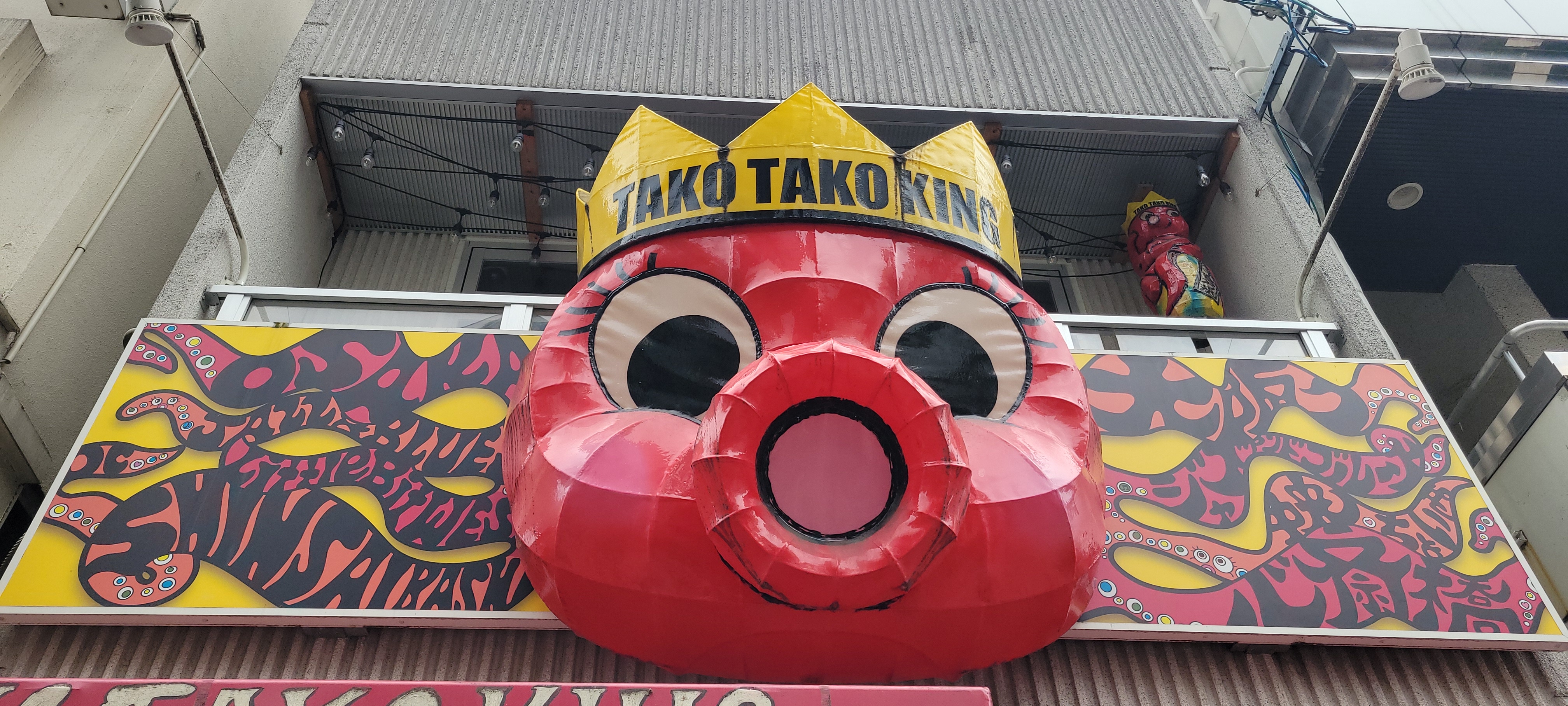
Confetti falling. Bells ringing. Giant Takoyaki Octopus saying, “Woohoo!”
Scientifically speaking, it is actually not correct to say that it is always darkest before the dawn, but the phrase gets another win for metaphorical accuracy in this case. After a month here in Japan, educationally speaking, I am officially cooking with gas!
As previously stated, defeat is not a feeling I typically entertain for long. I relate to such feelings much like I might handle an unwanted telemarketing phone call (aren’t they all kind of unwanted?). They always come at the worst times. And as soon as you get on the phone with them, if your spam call filter let one slip by and you thought that unfamiliar number might be an important call you were expecting, you are making decisions about what route you will take to get off the phone. Are you going to be kind and gentle? Are you going to be rude? Are you going to be quick and to the point? How much of their schpiel will they get through before they get that dial tone? Either way, no credit cards are getting pulled out. Time to get back to dinner.
So, defeat did not stay long. Especially after my deus ex machina crepe intervention.
So, I came out of Friday determined to find my rhythm here. I spent the weekend reading the entire Genki 1 textbook cover to cover (in addition to some other really cool travel adventures that I’ll write about in another post) to try and give myself some of the educational foundation that I had been looking for so that I wouldn’t feel totally dependent on whether or not my school was able to give me exactly what I was needing and so that, whatever they offered, I could show up fully and make the most out of it.
I wasn’t the only one using the weekend to figure out how to get me on track. I have to give high praise to my school, LDL. They could have given up on me. They could have just said, “Hey lady, this is how we do things. Get with the program.” Well, how they do things is they do their best to support each student to learn the way that they best learn. They came out of Friday determined to do everything in their part to be a great dance partner so that we could find the beat together. I got the kindest text from the student advisor checking in on me since I had left class early and asking questions to participate in the “let’s figure out how to hit the ground running next week” pursuit.
When I came into class on Monday, the head of the study program that had said some things on Friday that indicated that figuring out how to give me what I was asking for was, confusing at best, showed up with a warm welcome and the clarity of exactly what I was needing.
That’s a pretty incredible thing and I must take my hats off to LDL for playing a significant role in helping me find the beat after 4 weeks in Japan. I’ve found, over the course of my trip that the world of language learning is absolutely chock full of tremendous people that genuinely want to listen and help others along towards progress. I haven’t gone to one school that hasn’t given it their all for all of their students and done everything in their power to help me, and all of their other learners feel at home, comfortable and achieve their linguistic goals, as best they could. That said, it’s a tough task. Especially in the case of me showing up to this school at the last minute. To meet someone brand new and, within a few days, across any distance that might be provided by cultural differences, to nail it right out of the gate and completely understand the personal preferences and learning styles of what was, until days before, a total stranger – that’s a tall order.
So, after both myself and my school took the benefit of the weekend to troubleshoot and seek solutions, Monday was on fire! The good kind.
I had another new teacher and she came in with the understanding of what I was seeking. Within minutes of the beginning of class, I was elated. Once again, like the Wednedsay before, my brain was gorging itself on knowledge, and a steady stream of it, all delicious and all digestible and at a pace that kept me thoroughly pumped.
I came in with my textbook marked up from chapter 1 to 12. I had gone through every chapter and put checkmarks by the words and grammar concepts I knew and open checkboxes by the ones I didn’t. I had checkboxes and checkmarks in every single chapter going all the way back to the beginning. My Japanese foundation was indeed, a pile of ready-to-melt on some delicious linguistic Reuben sandwich, Swiss cheese. Time to make a meal out of it!
We started where me and my Wednesday teacher had left off, at Chapter 4. One by one, we went through each of my open checkboxes and reviewed them and practiced them until I was ready to put a checkmark in the box. We were cruising right through the material until we got to what looked, on the outside, like the simplest grammar point. Even though I already used this element often and with relative ease, it still got a checkbox when I was going over the book. That checkbox turned out to be the entryway into an epic adventure in linguistic spelunking. We spent nearly the next hour trying to wrangle this seemingly simple piece of Japanese into a table that my brain could digest. In the process, I almost broke my teacher’s brain too.
Watch out, it’s about to get nerdy.
See, one of the first things you will learn in Japanese is how to form a simple sentence. A sentence like, “I am Julie.” Well, you might not learn, “I am Julie.” exactly, but you get the point. Maybe, “My name is insert name here.” or another classic, “I am insert nationality here.” or any one of a number basic “I am sentences.” Good place to start.
In Japanese, the “I am” part comes from the word at the end of your sentence, “desu” (most often pronounced, “dess”). “Watashi wa Julie dess.” is how it would sound in English. In Japanese, 私はジュリです。
Simple enough.
Well, in chapter 4 of the Genki textbook, they very simply show, the past tense of “desu” as well as the negative form of “desu” to indicate that something “was” or “is not” something, and the negative past, to indicate that something “was not”, something.
Okay, no big deal.
However, the present and past negative form was something that was getting confused, at least in my brain, with the past negative form of the verb, “arimasu”, (the dictionary form that is kind of like what we would call an infinitive, is “aru”) which is a different type of existence verb.
In English, we have one verb, “to be”. We use it for people, animals, things and to also say that something does or does not exist. So, we use “to be” to say, “I am Julie.” “She is tired.” “We are late.” “The apple is ripe.” “The sun is shining.” and “Learning Japanese is fun.” We also use it to say, “There are five ripe apples on the table.” “There is one cookie left.” and “There are so many great verb forms in Japanese.”
In Japanese, they have three different verbs to accomplish the task of explaining existence. Fair enough. Existance is a pretty big nut to crack. Why not throw three verbs its way.
There is “Desu.”, “Iimasu.” and “Arimasu.” For our first piece of confusion for the English speaking mind…”desu” is not actually, technically a verb.
Huh?
So everything we are gonna learn that happens to verbs in about a billion different verb forms that we have yet to learn, the only one of them that happens with “Desu” is that it has a past and a negative form. (There are a few other forms that “desu” gets special, but that’s much later down the line.) And this whole, “there is” and “there are” thing – that’s split up between “Iimasu” (pronounced ee-mah-ss) and “Arimasu” (pronounced ah-ri-mah-ss). “Iimasu” is for living things like people and animals. “Arimasu” is for all the rest.
Are you still with me?
Well, when I looked in that “simple” little table that listed the past and present negative tense for “desu”, it reminded me an awful lot of the ones for “arimasu”.
I was confused and wanted to sort out which is which.
Oh, and just the page before, there had been a little footnote in my textbook telling me that I could also use “arimasu”, the “there is/there are” “to be” verb to actually say that something is or is not something else. “Ringo ga arimasen.” means, “There are no apple.s” “Ringo jya arimasen.” mean, “It is not an apple.”.
Okey doke.
See, the thing with language is this. It is under no obligation to be organized or simple or to make complete sense. To anyone. We English speakers, those of us paying any attention, know that oh so well. Pronounce “comb”, “womb” and “bomb”. How’s that idea of sense and consistency going for ya?
The reason for such pieces of insanity that boggle all non-native speakers in whatever language they are attempting to learn is simple.
Language is actually a living creature.
That means it is filled with flaws and imperfections and inconsistencies. That is life. That is what it is to be alive. We are all bundles of tangled threads – some beautiful, coherent, sense-making, bits and then all of the exceptions to the rules that turn the world upside down.
As far as I’m concerned, that is what makes it all so beautiful.
Language and life.
That is also why being a native speaker of a language is such a wonderful thing, because it is not an academic feat to know your language.
It is an expression of life lived.
You know a language because you live with that language. You know it because it is part of the oftentimes incoherent, chaotic and beautiful flow of living your life day in and day out, mixing and mingling with all of the other wonderfully chaotic and simultaneously coherent and incoherent creatures that you will encounter in a day, yourself included. And, because we are also living beings, we have a way of bonding with and making sense out of things that don’t make any sense, not with our thinking brains, but with the experience of waking up every day and finding our way from sunrise to sunset, through the maze of it all. That’s where language lives. And that’s where we live too.
When you peer inside your own native language, you just might found a feeling of amazement at the fact that you know it as well as you do. And you had a fairly strong foothold into all of that by the time you were 2!
But, when you are learning a language as a second language, there is not always the same amount of time and geography and circumstance to learn through living. That’s where the thinking brain comes in to boost things along. And the thinking brain wants sense, or at least, to understand how things that don’t make sense fit together.
So, me and my thinking brain asked my teacher to help me sort out the difference between the present and past, positive and negative forms of “arimasu” and “desu” so I could untangle the threads that were getting mixed up in the “Broca area” of my brain – the one in charge of processing grammar.
What happened next consumed a good hour of our time and not only boggled my mind, but got my teacher’s all tied up in a knot too. Yes, I managed to confuse my teacher about her own native language. Impressive, I know. And this is why I am a danger to a group lesson and best kept in my own playpen.
First of all, it turns out there are 4 different forms of saying that there wasn’t something inanimate. There are three in a polite form and one in a casual form – because Japanese has a whole different way of speaking when you are talking with friends and family versus more formal situations. Then, among the polite form of speaking, there is a form that is rarely used – mostly in written language – there is the formal polite version and then a casual polite version.
Then, when you go through the present forms and positive, some of those categories have a form, some don’t.
Yikes.
I was furiously (in the focused way, not the made way) making a table to figure this all out and wondering why the heck there isn’t a table that already exists in a book. I can’t be the first person to get confused about this!?
Seems like, maybe I am? I dunno. But we were definitely breaking some kind of new ground here, a fact that only boggled my already boggled mind further. What is everyone else getting that I am not? It doesn’t really matter. This was fascinating as hell and I was eating it all up.
As we sorted through the table, every time we thought we had it all worked out which forms were for desu and which ones were for arimasu, I would try to apply them in an example and my teachers face would scrunch up as she heard the sentence and said, “Nope, that’s not what that means.”
“Huh?!” We both scratched our heads.
At the end of it, we both came out of it thinking that there was only one form where the two “verbs” (remember, desu is not really a verb – only kinda sorta – technically it is called an auxiliary verb, but also a sentence-ending particle, oy) overlapped to share a form. But then, we weren’t sure.
We landed with a pretty good table that we were fairly ceratin was solid. My teacher surrendered to the table at hand and added the footnote that she’d have to go home and think about it to be sure! What? I broke my teacher? Oops.
Julie, this is why we can’t have nice things.
So, I am awaiting class today with baited breath to see what she found out.
After writing out our hour long deep-dive into Japanese’s “to be” verbs, what amounts to a literal existential crisis, you might think I was not feeling the beat.
Oh man, just the opposite. Because, before we pulled all of this mess out and laid it on the table, this is exactly why I would find myself walking around never quite feeling solid, even in the Japanese I had already learned. There was always this slight feeling of uncertainty and confusion and now we were finally getting to the bottom of it.
If you’ve gotten this far in this post, congratulations, you have officially nerded out over language.
Well, “to be or not to be”, that was definitely the question of the day. Nailed it, Willy.
And, I am going with “to be”. It was an absolutely great day and I’m pretty excited now that I will have one full week to dance to the rhythm, feeling the beat learning Japanese.
Well, if yesterday’s linguistic productivity was not enough, we ended our day on another safari out into the wilds of Japanese and I got another little coincidence that felt like a reward for an obstacle overcome.
On the safari, like my teacher the prior Wedneday, my sensei used every moment to help educate me. We walked the streets of Osaka and she pointed out things, teaching me how to say them in Japanese. I learned and proceeded to immediately forget words to describe the not-so-busy streets we walked and the difference between “it is raining” and “it is just starting to rain”, since it was, well, “just starting to rain”. I wasn’t worried about the immediate forgetting because this is how language learning works. Rarely does remembering happen the first time. The first time I hear something, a little room gets built in my brain. A room where that word will eventually live. It makes it so that the next time I hear it, or the next time I need it, there is this subtle feeling of familiarity. That second time I ask for the word, sometimes it moves into that room. Sometimes it just visits and then leaves again. Some words, I have to court them four, five or more times before they are willing to take up permanent residence in my brain. Some are convinced more quickly. Either way, the process begins.
In my last post, describing Japanese as a language, I mentioned that, to me, Japanese is kind of like Legos and, if you have ever been to a Lego store, you know that some pretty amazing things can get built out of Legos. Well, it seemed the perfect ending to the day where I finally found my linguistic rhythm here in Japan that our little outing landed us in the Lego Store! And right there was a massive Lego sculpture of a Japanese chef cooking up the local specialties, Okonomiyaki and Takoyaki, all out of Legos.


So, yea, I’m here in Japan and, linguistically, I’m finally cooking with gas, or cooking with Legos. Whichever it is, a delicious linguistic feast of is on the way!

Leave a Reply